


 English
 日本語
日本語 русский
 Español
 Deutsch
Content
- 1 Why Chemical Plant Maintenance Creates a Two-Hazard Problem
- 2 Reading a Cut Rating Without Getting Fooled
- 3 Matching the Glove to the Maintenance Task
- 4 Chemical Barrier: Permeation, Degradation and Breakthrough Time
- 5 Fit, Grip and the Real Cost of a Glove
- 6 A Procurement Checklist You Can Put in the Specification
- 7 Frequently Asked Questions
A maintenance crew is opening a pump casing on a caustic transfer line. The bolts come off clean, the casing breaks free, and a thin film of 25 percent sodium hydroxide runs down the flange face toward the technician's wrist. Two metres away, a second technician is scraping off a failed gasket, dragging a blade across metal in short, hard strokes. Both are exposed to the same two hazard families in the same minute, and that overlap is where most glove programmes quietly fail.
Here is the answer before the details. For chemical plant maintenance, specify a dual-rated glove: a cut-resistant liner with a documented TDM-100 result at ANSI A4 to A6, combined with permeation data for the specific chemicals in that job, and a breakthrough time longer than the longest realistic contact in the task. Gloves rated on only one of those two axes are a deliberate compromise, not a safe default. What follows explains how to build that specification, what the numbers mean, and where the common buying mistakes happen.
Why Chemical Plant Maintenance Creates a Two-Hazard Problem
The edge inventory inside a chemical plant is unusually varied: glass-lined reactor ports, expanded metal grating, banding straps on drums, cable tray, wire rope, sheet metal duct, broken sight glass, and hardened product scale that flakes off sharp. Hand tools slip when a wrench lets go. On top of the mechanical risk sits the process itself, which brings caustic, mineral acids, hypochlorite, amines, hydrocarbon solvents and hydraulic fluid into the same workspace.
Each failure mode feeds the other. A cut through the liner lets process fluid reach skin. A chemically degraded material then cuts and tears at lower loads. A glove that is uncomfortable gets pulled off at the wrong moment, and a bare hand has no rating at all.
The usual mistake is treating the two requirements as one purchase. Aramid and HPPE liners are strong cut platforms, but the liner alone is not a chemical barrier. A palm coating is not a barrier either: nitrile and PU coatings manage abrasion, oil and light splash, and they do not replace a permeation-tested film. Specification-grade gloves solve both problems with two components, a cut-rated knit liner and a chemical-resistant film system, each tested and documented separately.
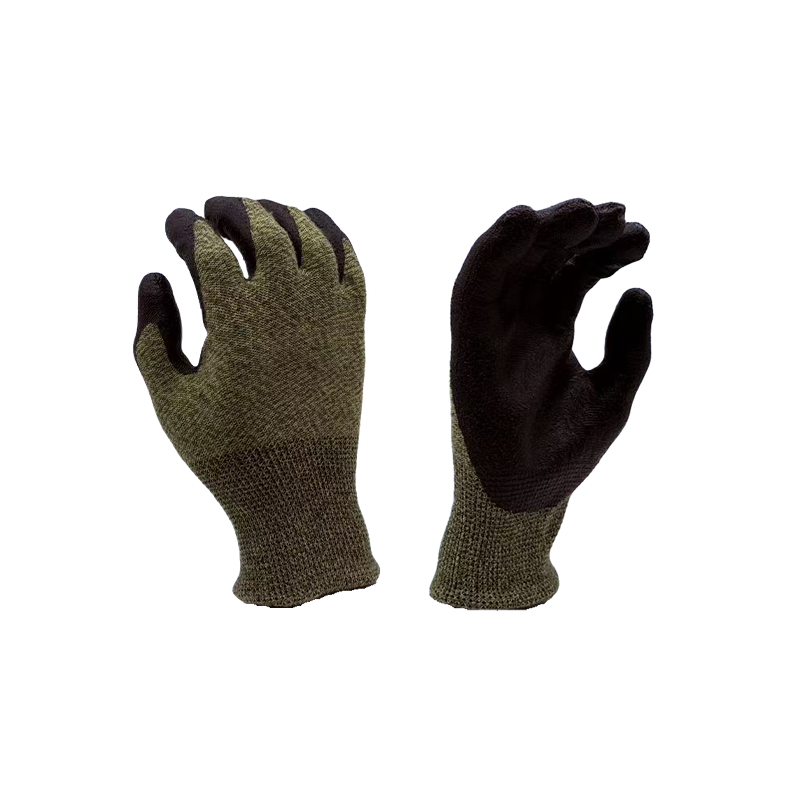 Cut Resistant Chemical Protection Gloves SupplierThe Cut Resistant Chemical Protection Gloves are designed as a reliable solution for professionals working in environments where both sharp objects and hazardous chemi...View Product →
Reading a Cut Rating Without Getting Fooled
Two cut scales are in circulation and they are not interchangeable. ANSI/ISEA 105 runs from A1 to A9. EN 388:2016 reports a letter from A to F. Both of those use the TDM-100 test to ISO 13997, which slides a straight blade across the material and reports the load in newtons required to cut through after a fixed travel distance. The older Coup test, still printed as the first number in an EN 388 string, uses a rotating circular blade that dulls as it works, which makes it unreliable on high-performance liners and inconsistent on coated gloves.
The practical consequence: when a supplier quotes "level 5", ask which method produced that number. For maintenance work around metal edges, request the TDM-100 result in newtons, or the matching ANSI level from the ANSI A2 to A8 cut protection range. Wet and oily conditions also cost you performance, since a liner tested dry on a bench can lose a meaningful share of its resistance once it is saturated with oil, which is the normal state of a glove at a seal change or a valve repack.
Higher cut levels are not free. Blends that reach A6 and above are thicker and stiffer than an A3 knit, and the trade-off lands directly on the person wearing them.
The index above is an editorial weighting for comparison only, not a measured test value. One more ground rule: nothing is cut-proof. A rating describes how much load the material resists under a defined test, not a promise that the glove cannot be cut. Workers who hear "cut-proof" take fewer precautions, which is a safety problem by itself.
Matching the Glove to the Maintenance Task
Start with the task list, then the chemical list, then the glove. The table below is a workable starting point for a hazard assessment, not a finished specification.
| Maintenance task | Dominant risks | Cut level starting point | Construction notes |
|---|---|---|---|
| Valve, flange and gasket work on process lines | Sharp gasket edges, residual product, wrench slip | A4 to A5 | 15 to 18 gauge liner, nitrile palm coating for oily grip, gauntlet cuff |
| Pump and mechanical seal replacement | Sharp wear rings, solvent contact, tight clearances | A4 to A5 | PU coating for dry grip, snug fit for small fasteners |
| Opening vessels, drums and reactors | Sharp vessel mouths, splash, hot surfaces | A5 to A6 | Longer cuff, sleeve or arm protection |
| Gasket scraping and surface preparation | Slicing edges, hand tool slip | A6 | Back-of-hand impact protection |
| Glass-lined and glass component handling | Fine shards, low abrasion | A5 | High dexterity, thin 18 gauge liner |
| Drum, banding strap and wire rope handling | Cut plus puncture | A5 to A6 | Abrasion-resistant coating |
| Instrument work near static-sensitive areas | Static discharge, small fasteners | A3 to A5 | Antistatic construction, thin liner |
| Steam, hot condensate and cold lines | Heat or cold plus cut | A5 | Thermal-rated liner, dry grip |
Two additions are worth planning for. First, tasks that combine a stuck fastener with a sharp edge justify back-of-hand impact protection as well as cut resistance, because a wrench that slips under load produces both a laceration and a crush risk. Second, whenever a technician reaches into a vessel opening, a drum mouth or a section of grating, the hand is not the only exposed surface; a cut-rated sleeve or arm protector covers the forearm that the glove cannot.
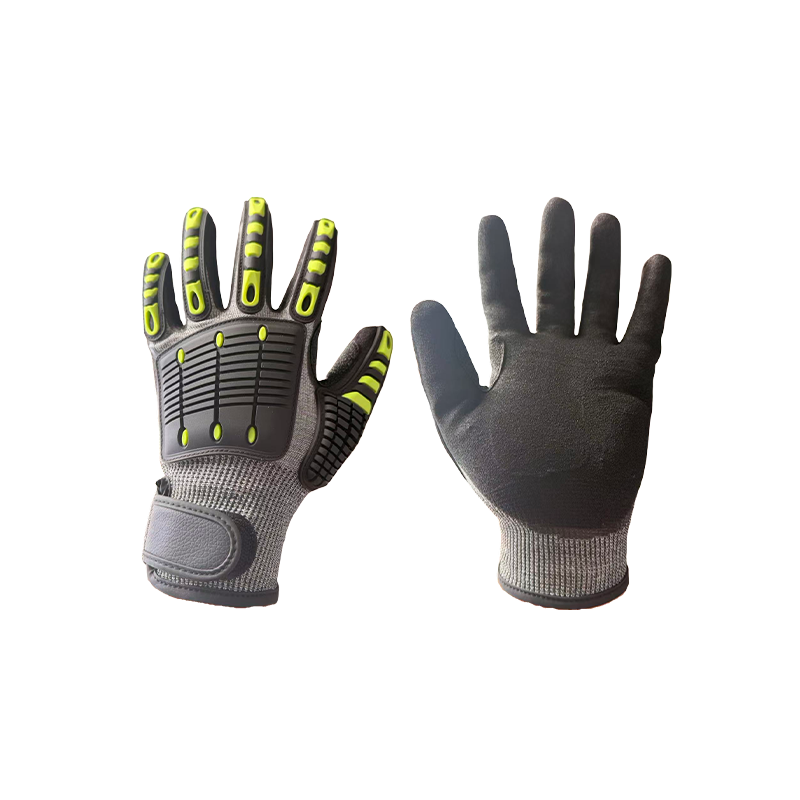 A6 Cut-resistant TPR Shock-absorbing GlovesThis glove features an 18-gauge precision-knit inner liner for flexible fit and incorporates tungsten fiber material to deliver top-level A6 cut resistance. The TPR an...View Product →
Chemical Barrier: Permeation, Degradation and Breakthrough Time
Two different things happen when a glove meets a chemical, and only one of them is visible. Degradation is a physical change such as swelling, softening, hardening or cracking, and a degraded glove is usually obvious. Permeation is molecular movement through material that still looks intact. A glove can be passing chemical through its film for twenty minutes while appearing new, which is why "it still looks fine" is not a change-out rule.
Breakthrough time, reported in minutes, is the number that matters. Under EN ISO 374-1, a Type A glove has been tested against at least six chemicals with a breakthrough time of 30 minutes or more, Type B covers three chemicals at 30 minutes, and Type C covers one chemical at 10 minutes. Type A sounds like blanket protection and is not: it is valid only for the specific chemicals on that glove's published list. Match the list against your SDS data, chemical by chemical, and set the change-out interval below the shortest breakthrough time you are likely to meet.
Materials behave differently, and no single one covers a mixed plant. Nitrile handles oils, greases, aliphatic hydrocarbons and many acids well and is a sensible default for general maintenance. Neoprene adds acid and caustic performance. Butyl is the choice for ketones and esters where nitrile fails. PVA stands up to aromatic solvents but is destroyed by water. Where one task genuinely combines incompatible chemistries with sharp edges, layering works: a thin barrier glove underneath, a cut-resistant shell on top, with the caveat that a soaked shell holds liquid against the barrier.
Type A Chemical Protection Gloves SupplierType A Chemical Protection Gloves are specifically designed to safeguard users from exposure to a wide range of chemicals, including splashes, spills, and direct conta...View Product →Fit, Grip and the Real Cost of a Glove
Most field failures are not material failures. They are gloves that came off. Fit drives that more than any data sheet. Fingertips should sit close without wrinkling, the cuff should still cover the wrist when the hand flexes, and nothing should bunch at the knuckles where it can catch on a flange bolt or a grating edge. Order two sizes, let the crew try both, and treat a rejected glove size as a purchasing error rather than a worker preference.
Grip matters just as much. A hand that is slipping grips harder, the forearm tires, and the glove comes off. Nitrile foam and sanded finishes work on oily surfaces; smooth PU grips better when the surface is dry. Gauge is a proxy for feel: an 18 gauge liner gives noticeably better dexterity on small fasteners than a 13 gauge one, and gives up some durability in return.
- Hand injuries and lost time - 35%
- Purchase price - 30%
- Replacement frequency - 25%
- Storage, fit and disposal - 10%
The split above is an illustrative planning weighting, not a measured result, but the direction holds. A cheaper pair that has to be replaced twice as often, or that stops a single laceration, usually costs more than the pair that was specified properly in the first place. Buyers who compare only the invoice price are comparing the smallest part of the bill.
A Procurement Checklist You Can Put in the Specification
Whether you order from stock or commission a custom build, the same sequence keeps a glove programme defensible:
- List the chemicals by name and concentration, taken from the SDS rather than from memory or from the process label colour.
- Collect permeation and degradation data for those exact chemicals, not for a family name such as "acids" or "solvents".
- Set the cut level using TDM-100 or ANSI numbers that match the worst edge in the task, not the average edge.
- Choose the coating for grip in the real working condition, oily or dry, and confirm the coating is not being used as the chemical barrier.
- Check glove length and cuff style against the splash direction, and add sleeve or arm protection for any reach-in task.
- Verify sizing across the actual crew rather than a single sample size.
- Run a two to four week trial with a small team and record why gloves are removed, how fast they wear out, and any near misses.
- Write a change-out rule based on breakthrough time and wear, then keep that specification on file for every reorder.
If you would like the numbers checked before you commit to a purchase, send the chemical list and the task list through our quote request form and we will map them against tested constructions.
Frequently Asked Questions
Can one glove cover both cut and chemical risk in a plant?
Often yes, but only within limits. A nitrile-coated cut-resistant liner handles dilute acids, oils and mechanical edges in one item, and that combination covers a large share of routine maintenance. Nitrile has poor resistance to ketones and several chlorinated solvents, so if your chemical list includes those, plan to switch gloves between tasks or layer a barrier glove under a cut-resistant shell.
What cut level should a chemical plant maintenance team standardise on?
A4 to A5 covers most routine work with metal edges, banding straps and grating without destroying dexterity. Move to A6 and above for scraping, cutting and glass-lined vessel work, and accept the loss of feel. A2 and A3 are generally too light for maintenance unless the task is light assembly or instrument work on small components.
How long can a chemical-protective glove be worn?
Until you approach the breakthrough time for the chemical, minus a safety margin. If the manufacturer reports a 60 minute breakthrough and the task runs 40 minutes, that is one glove per task, not one glove per shift. A liquid that has already reached the inside of a glove stays against the skin, so a glove that is wet through is worse than a bare hand in some situations.
Does a higher cut level always mean a better glove?
No. It means more cut resistance, usually at the cost of dexterity, breathability and price. The right level is the one the task demands, because an over-specified glove that is too hot or too stiff will end up in a pocket instead of on a hand.