



 English
 日本語
日本語 русский
 Español
 Deutsch
Content
The 15,000-volt problem on a 100-volt line
The arithmetic of ESD damage is not intuitive. A person who walks across a vinyl floor can build up about 7,000 volts. Walking across a carpet can generate 35,000 volts. Picking up a plastic bag at a protective bagging station can add another 20,000 volts. Yet a standard MOS integrated circuit can be permanently damaged by a discharge of 100 volts or less, and some modern microchips are sensitive below 10 volts.
On an electronics assembly line, this gap is the reason anti-static gloves are a quality-control requirement rather than a comfort item. A glove that is not dissipative can carry a charge and release it into a component at the moment of contact. The result is not always visible: the device may pass final testing and fail in the field. The cost of that failure, including rework, RMA, and lost customer trust, is far higher than the price of a correct pair of gloves.
In practice, then, the choice is not "gloves or no gloves". It is "gloves that drain the charge, or gloves that hold it and wait for a contact that can end a whole batch."
What anti-static gloves actually do
An anti-static glove works by providing a controlled low-resistance path. The charge generated on the operator's hand, sleeve, or the glove itself is drained through the body to the grounded floor, or at least through the glove's own conductive yarn to the nearest ground point. That controlled bleed prevents the sudden spark that kills a component.
The key word is "controlled". A fully conductive glove, with surface resistance below 104 Ω, may drain too fast and create a low-impedance path near circuit boards. An insulative glove, typically a plain latex or nitrile glove, does the opposite: it stores charge and releases it when the operator touches a grounded surface. The useful middle ground is the dissipative range.
| Class | Surface resistance (Ω) | Practical behavior |
|---|---|---|
| Insulative | > 108 | Traps charge; not safe in an Electrostatic Protected Area |
| Dissipative | 104 to 108 | Bleeds charge slowly; safe for electronic assembly |
| Conductive | < 104 | Drains very fast; can be risky near low-voltage circuits |
When you evaluate a glove, do not stop at the label. Ask the supplier for a surface resistance measurement on the actual glove, not just the yarn. A good pair should stay in the dissipative range after several machine washes, because laundering can remove the conductive coating or disturb the knit structure.
What to check when buying for an assembly line
Procurement teams often start with the cheapest coated glove that says "anti-static". The safer route is to decide from the workstation. Fine-pitch PCB work needs fingertip dexterity. Confirmed soldering stations need oil resistance. Packing and kitting benches produce abrasion. The table below shows the common construction families and where each one fits.
| Construction | Typical resistance | Key strength | Best application |
|---|---|---|---|
| PU-coated knit with conductive yarn | 104–107 Ω | Dexterity and soft fit | Fine PCB handling and small-component assembly |
| Carbon-fiber knit | 103–106 Ω | Strong dissipation | Handling bare boards and ESD-sensitive components |
| Nitrile-dipped ESD formulation | 104–108 Ω | Oil and wet-slip grip | Soldering, cleaning, and rework stations |
| PVC-dot coated anti-static | 105–108 Ω | Abrasion resistance | Rough handling and packing with high friction |
Beyond the construction, confirm the fit. Seamless 13-gauge or 15-gauge knits reduce seams that snag on components and improve touch sensitivity. A slightly form-fitting palm also improves grip without over-tensing the finger muscles during a long shift. If the line runs eight or more hours, breathability becomes a retention issue: operators who are uncomfortable will take gloves off, and that is when ESD risk climbs back up.
For a deeper view of matching glove properties to industrial tasks, see this guide to choosing functional gloves. It covers the same trade-offs applied to temperature, chemical, and mechanical risks.
ESD and cut protection on the same pair
One mistake in glove selection is treating ESD and mechanical hazards as separate problems. On many electronics assembly lines, they share the same pair of hands. PCB edges can slice through a thin PU-coated glaze. A metal bracket or connector housing can cut a knuckle. If the operator then changes into a standard cut-resistant glove to protect against those edges, the line loses ESD protection exactly where it matters.
The practical answer is a glove that carries both ratings. ANSI cut levels A3, A4, or A5 are common for electronics assembly because they handle the tough edges without turning the hand into a stiff, clumsy tool. An anti-static PU coating can be applied directly to such a knit, so the same pair drains charge and blocks minor cuts. This is why a combined A5 anti-static PU glove is a reasonable part of an EPA near the mechanical assembly stage.
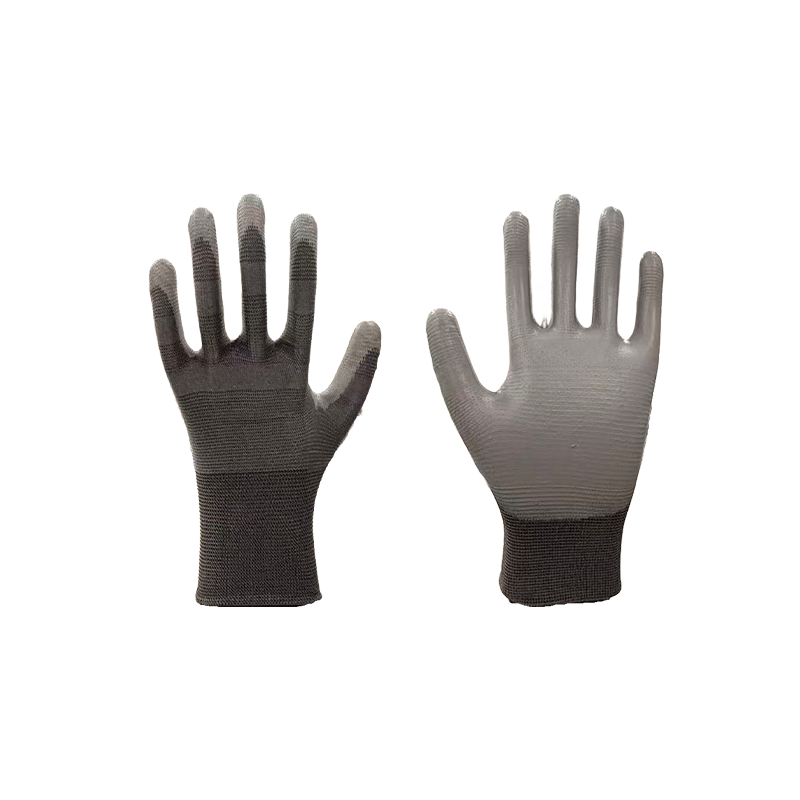 A5 Cut-Resistant Anti-Static PU Gloves for Precision WorkThis 18-gauge ultra-thin glove combines HPPE and carbon fiber knit for A5 cut resistance and anti-static properties with a PU palm coating, making it suitable for EPA tasks requiring both protection and tactile sensitivity.View Product →
When reviewing a combined glove, check that the cut level is not achieved by adding a bulky inner liner that impairs tactile feedback. The cut resistance should come from the knit yarn, not from an extra pad that makes small components hard to feel.
Standards, batches, and the questions to ask
ANSI/ESD S20.20 and IEC 61340-5-1 are the two frameworks that define how an Electrostatic Protected Area should behave. Both require not just one glove, but a complete system: grounded workstations, dissipative flooring, controlled personnel movement, and gloves or finger cots that keep the operator from becoming a capacitor.
In practice, the standard matters because it forces the glove supplier to provide reproducible performance. When your purchasing team compares proposals, ask for:
- Surface resistance values from a recent batch, not from a one-time lab sample.
- The retail packaging in which the gloves are delivered, to confirm they stay within an EPA while stored.
- Whether the glove can be laundered without a jump in resistance, since many lines reuse gloves over several shifts.
- A batch number or traceability code that the warehouse can log against each line.
A supplier that only shows a generic datasheet is less useful than one that can answer these four questions with measured results.
FAQ
Can I use ordinary latex or nitrile gloves for ESD protection?
No. Plain latex and nitrile are insulative. They store charge and can discharge it into a component when touched. An anti-static glove includes conductive yarn, a coating, or both to create a dissipative path.
How often should I replace anti-static gloves?
There is no single answer. A practical rule is to check surface resistance after each wash cycle of the glove and replace any pair that drifts outside the dissipative range. Visual signs of coating wear, holes, or permanent staining are also triggers.
Do I need anti-static gloves at every station on an electronics line?
Any station where an operator touches ESD-sensitive components or boards should use them. Packing, kitting, and assembly stations are common examples. A workstation that is not part of the protected area may still benefit, but the decision should be based on the component's sensitivity.
What does "A5" mean on an anti-static glove?
A5 is an ANSI cut level. It is a separate mechanical rating from the glove's ESD behavior. A glove can be A5 for cut resistance and still be dissipative if it combines those two properties.
Choosing a supplier who can back up the datasheet
The final piece is procurement trust. On an assembly line, the cost of a glove failure is measured in scrapped boards, not in cents per pair. A manufacturer with in-house R&D, a lab, and the ability to customise the knit or coating for your specific product is a practical partner. They can also provide a consistent batch-to-batch resistance range and packaging that protects the ESD performance through the warehouse.
A partner with its own production workshop and quality checks, like our Jiangsu Shunhao operation, can also supply custom solutions without an extra trading layer. That means the resistance range, cut level, and coating are decided with the factory directly, and a trial batch can be adjusted before a large PO is placed.
When you are ready to compare options, request a quote with your workstation description and component sensitivity. That information is enough to narrow the glove construction, surface resistance target, and cut level before the trial batch is sent.