



 English
 日本語
日本語 русский
 Español
 Deutsch
Content
- 1 Where Cuts Actually Happen in Metal Fabrication
- 2 Reading ANSI Cut Levels Without Overbuying
- 3 The Fibers Behind the Cut Rating
- 4 Coatings, Grip and Abrasion
- 5 Impact and Crush Hazards Around Press Brakes and Shears
- 6 Fit, Sizing and Cuff Length Decide Whether the Rating Gets Used
- 7 A Procurement Checklist for Safety Managers
- 8 Frequently Asked Questions
Pick a freshly sheared steel blank off a stack and the problem shows up within two seconds. A burr on the bottom edge catches the glove, the palm slides on a film of oil, and the hand twists. That combination of a sharp edge, weak grip and a loose fit is what sends fabricators to the first-aid room, not the sharp edge on its own.
The short answer first: for most metal fabrication work, standardise on ANSI A4 to A6 cut protection with a nitrile or PU palm coating, a close fit and a cuff that covers the wrist. A2 and A3 are enough for inspection benches and light assembly. A7 and A8 belong on scrap handling and heavy shear work, where hands meet raw edges all shift long. Buying a single level for the whole plant is the most common and most expensive mistake in hand protection.
Where Cuts Actually Happen in Metal Fabrication
Glove specifications are usually written from a catalogue. They hold up better when they are written from the floor. In sheet metal work, injuries cluster around three moments: pulling a blank off a stack, catching a part that slips, and reaching into a scrap bin. Each one calls for a different balance of cut level, grip and coverage.
| Task | Primary hazard | Starting cut level | Commonly overlooked |
|---|---|---|---|
| Sheet and blank handling | Burred edges, sharp coil ends | A4 to A5 | Grip on oily sheet, wrist coverage |
| Deburring and grinding | Abrasive contact, hot fines | A3 to A5 | Abrasion rating, heat resistance |
| Press brake and shear work | Sudden edge contact, pinching | A5 to A6 | Back-of-hand impact protection |
| Offcuts and scrap bins | Jagged, unpredictable edges | A6 to A8 | Puncture resistance, forearm coverage |
| Inspection and light assembly | Minor edge contact | A2 to A3 | Dexterity, fit, touch sensitivity |
Two of those rows drive most of the cost. Going up a level on the inspection bench buys nothing and costs dexterity. Staying one level too low on scrap handling is where the compensation claims come from.
Reading ANSI Cut Levels Without Overbuying
ANSI/ISEA 105 rates cut resistance from A1 to A9 using the ISO 13997 test, in which a rounded blade travels across the sample under increasing load until it cuts through. The result is recorded in gram-force: A4 is roughly 1,500 g, A5 about 2,200 g, A6 about 3,000 g, A7 around 4,000 g and A8 near 5,000 g. EN 388:2016 expresses the same ISO 13997 result differently, using letters A to F, so an EN 388 level D sits close to ANSI A5.
What matters on a fabrication floor is the test method, not just the number. Ratings built on the older coupe test can look impressive on hard, burred steel and then fail in service, because the coupe blade dulls as it travels. A blade that dulls rewards softer liners. The TDM method keeps the cutting edge consistent, which is why safety managers in metalwork should ask for the ISO 13997 figure on the specification sheet rather than accepting a headline level.
- A2 to A3: inspection, packing (25%)
- A4: general sheet handling (30%)
- A5 to A6: shearing, press work (30%)
- A7 and above: scrap handling (15%)
Illustrative split of cut levels across a mixed fabrication shop, based on typical task groupings.
A 13-gauge HPPE liner rated at ANSI A5 is the workhorse for most fabrication floors: enough cut resistance for sheared edges and deburring, thin enough that operators leave it on instead of pulling it off between jobs.
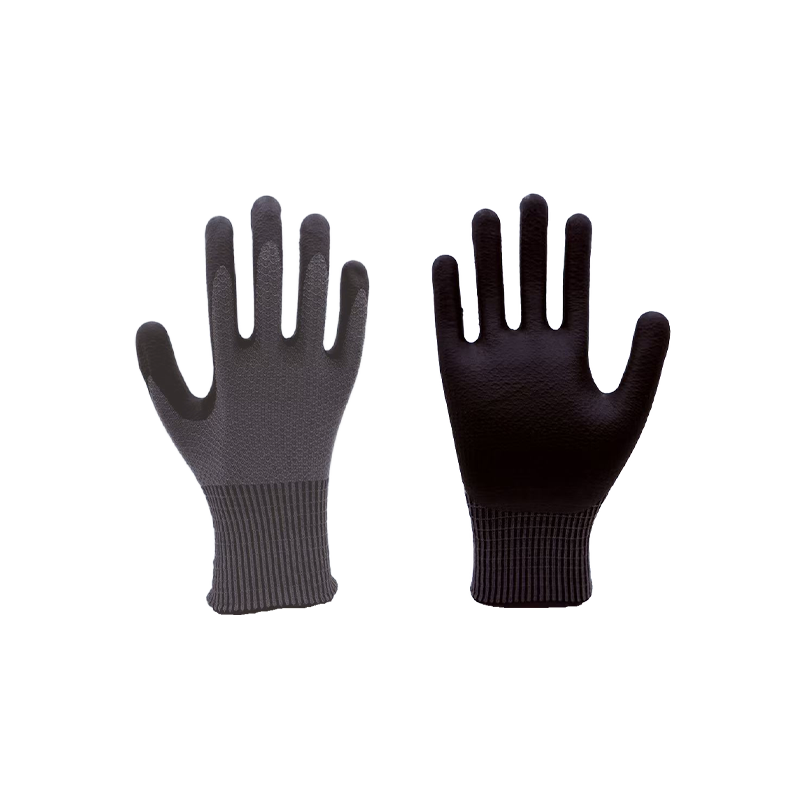 13-Gauge ANSI A5 Gray Cut-Resistant Safety GlovesA 13-gauge HPPE liner rated ANSI A5 for fabrication tasks; its thin build may suit sheared edges and deburring where workers keep gloves on.View Product →
The Fibers Behind the Cut Rating
The number on the box comes from the liner yarn and the way it is knitted. Four constructions cover almost everything used in metalwork, and each has a trade-off that shows up on the floor rather than on the spec sheet.
Typical ANSI cut ranges achieved by common liner constructions; actual performance depends on gauge, blend ratio and knitting density.
High-performance polyethylene blended with glass fibre is the most common route to A4 through A6. It is light, flexible and holds its rating when dry. Para-aramid brings heat and flame resistance, which suits welding support and hot-part handling, but it delivers less cut resistance per unit of weight, so it is usually blended rather than used alone. Steel wire cores push ratings into A7 and A8 and keep working when the liner is wet or oily, at the cost of weight, stiffness and a slower donning routine.
Gauge changes the result as well. An 18-gauge liner is thinner, cooler and more dexterous than a 13-gauge liner, but the finer yarn places less cut-resistant fibre into every square centimetre, so the same blend often rates one level lower at 18 gauge. If a specification moves from 13 to 18 gauge for comfort, the cut level should be re-checked rather than assumed.
Coatings, Grip and Abrasion
Cut resistance keeps the edge out of the skin. Grip decides whether the glove holds the part or rotates on it. Palm coatings do that work, and they also carry most of the abrasion.
| Coating | Grip on oily parts | Abrasion resistance | Flexibility | Where it fits |
|---|---|---|---|---|
| PU | Fair to good | Good | Excellent | Dry to lightly oiled parts, fine handling |
| Nitrile | Very good | Very good | Good | Oily sheet, general fabrication |
| Latex | Fair on oil, good when wet | Good | Very good | Dry parts and mixed wet tasks |
| Uncoated knit | Poor | Low | Best | Inspection benches, low-oil work |
Abrasion is graded separately from cut resistance, on a scale from 1 to 6, so a glove can carry a strong cut level and still wear through the palm in a week of deburring. Whenever grinding, deburring or handling of rough castings is part of the job, check the abrasion rating next to the cut rating instead of assuming the two move together.
Where abrasive contact and sharp edges arrive together, a fully immersed palm and a reinforced base add life to the glove without changing the liner.
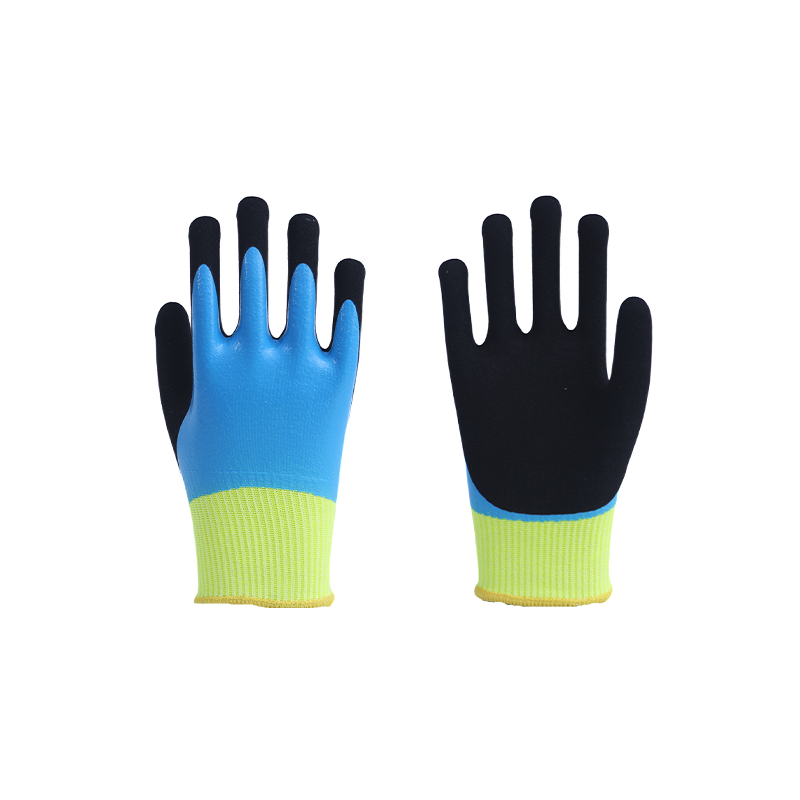 Fully Immersed Abrasive Cut-Resistant Work GlovesFor abrasive contact alongside sharp edges, the fully immersed palm and reinforced base are presented to extend glove life before bulk orders.View Product →
Dip materials are not interchangeable across a product range, and the choice of nitrile, latex or PU affects wet grip, softness and cost in different ways. A closer look at how each dip performs is worth the reading time before a bulk order is signed.
Compare nitrile, latex and PU dipping options before you commit to a bulk order.
Impact and Crush Hazards Around Press Brakes and Shears
Cut resistance says nothing about impact. A part can kick back off a press brake, an offcut can land on the knuckles, and a ram can close on the fingers. Back-of-hand protection is the answer, and it is graded separately. ANSI/ISEA 138 ranks impact gloves from level 1 to level 3 by the peak force transmitted through the knuckle area, with level 3 the most protective at roughly under 4 kN, against under 9 kN for level 1.
Combining a cut-resistant liner with moulded TPR on the back of the hand covers both risks in one glove, which matters on press brake and shear stations where operators will not change gloves between tasks.
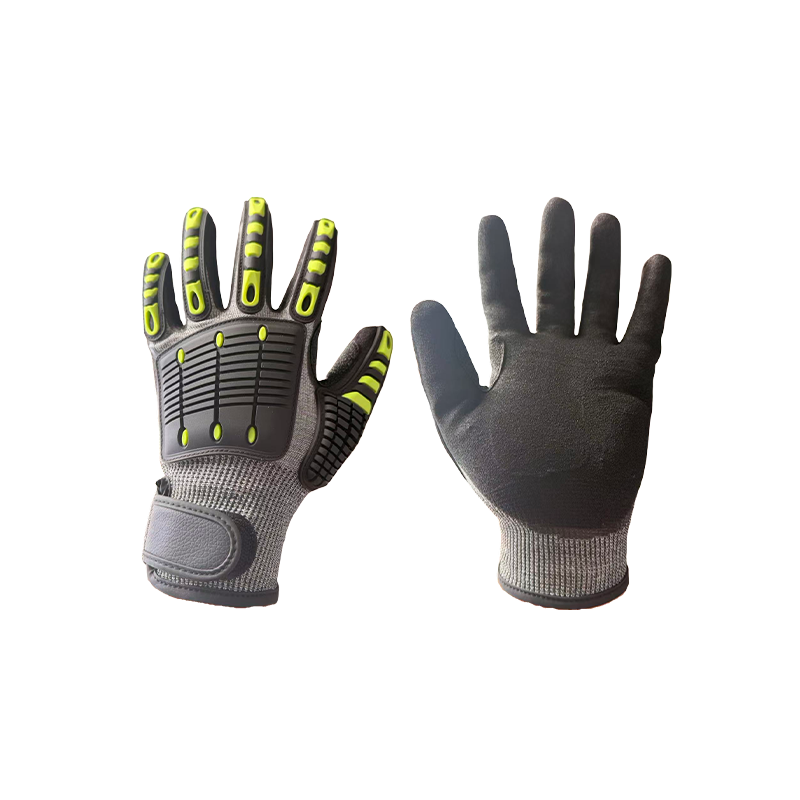 A6 Cut-Resistant TPR Shock-Absorbing Safety GlovesCombines an A6 cut-resistant liner with moulded TPR back-of-hand protection, suited to impact-risk stations where operators keep one pair on.View Product →
Impact padding does reduce flexibility and adds warmth, so it belongs on the stations where impact is a real hazard rather than on every pair in the plant.
Fit, Sizing and Cuff Length Decide Whether the Rating Gets Used
A glove with the right cut level and the wrong fit protects nobody, because it comes off.
- Loose gloves catch on burrs and get pulled off the hand; tight gloves cause fatigue and get cut down at the wrist by the end of a shift.
- A knit wrist keeps dexterity for bench work. A longer cuff, around 35 cm, suits deep oil or chemical contact and protects the forearm.
- The cuff hem is a common catch point. A burr that snags the hem rotates the whole glove and exposes the palm.
- Coating wear is the first sign of replacement. Once the palm coating wears through, cut performance drops quickly as the liner pills.
- Heat build-up matters in summer. Rotating two pairs per operator per shift keeps liners dry and gloves in use.
- If workers remove a glove to pick up a small fastener, the fit or the dexterity is wrong, not the worker.
A Procurement Checklist for Safety Managers
- Map each task to its real hazard: edge type, oil, heat, impact, chemical contact.
- Set a cut level per task group rather than one level for the whole plant.
- Ask for the ISO 13997 or TDM result in gram-force or newtons, not only the letter or number.
- Check abrasion and grip ratings alongside the cut rating.
- Order two sizes per crew and run a two-week floor trial before the bulk purchase.
- Confirm cuff length and coating for oily, wet or chemical-exposed stations.
- Compare replacement frequency and lead time, not only unit price per dozen.
- Ask about custom sizing, branding and packing if you plan to standardise across sites.
Most specification problems are cheaper to fix before the first container ships than after. If your task list includes a mix of sharp edges, oily sheet and impact stations, it is worth testing the specification against real samples first. Send your task list and request a quote so the cut levels, coatings and cuff lengths can be matched to the stations you actually run.
Frequently Asked Questions
Are A5 gloves enough for press brake work?
Usually for the cutting risk, but not always for the impact risk. A press brake station often needs a cut level of A5 or A6 combined with ANSI/ISEA 138 impact protection on the back of the hand.
Do cut-resistant gloves also stop punctures?
No, puncture resistance is tested separately. A liner that resists a sliding blade may still let a thin, jagged offcut through. For scrap bins, check puncture performance as well as cut level.
Can one glove type cover an entire fabrication shop?
It can be specified that way, but the cost is dexterity on light tasks and protection on heavy ones. Two or three levels covering inspection, general handling and scrap work will usually be cheaper overall.
How often should cut-resistant gloves be replaced?
When the palm coating wears through, when the liner pills or snags, or after contact with chemicals that break down the fibres. Cut performance drops with wear, so a worn A5 is not an A5.
Matching a cut level to each station, checking grip and abrasion next to it, and confirming the fit on a real shift covers nearly every failure mode in metal fabrication. Start with the hazard, then pick the glove, rather than the other way around.