



 English
 日本語
日本語 русский
 Español
 Deutsch
Content
- 1 What Actually Cuts, Burns and Slips Hands in Glass and Ceramics Work
- 2 Match the ANSI Cut Level to the Task, Not to the Yarn Name
- 3 When Your Buyer Asks for EN 388 Instead
- 4 Grip and Coating Decide Whether the Glove Is Actually Worn
- 5 Sleeves, Cuffs and Forearm Coverage for Full Sheets
- 6 A Five-Point Trial Before You Order a Pallet
- 7 Frequently Asked Questions
A 3,210 x 2,250 mm sheet of 6 mm float glass weighs around 108 kg. Two people can move it, but only if both keep a firm hold on a freshly cut edge that behaves like a blade once load is applied. The same pressure shows up in a ceramics plant when someone lifts a stack of greenware by a chipped rim, or slides a glazed tile out of a rack with wet hands.
For glass and ceramics handling, the practical starting point is an ANSI A4 to A6 cut-resistant glove, with the coating matched to the surface condition (dry, wet or dusty) and forearm coverage added whenever full sheets are involved. Climbing higher on the cut scale is not automatically safer: each step up usually costs dexterity, and a dropped pane causes injuries that no cut rating prevents.
The sections below explain how the hazard profile breaks down, where the ANSI and EN cut scales diverge, and how to run a trial that ends in a purchase decision instead of a drawer full of samples.
What Actually Cuts, Burns and Slips Hands in Glass and Ceramics Work
Treating "sharp material" as a single risk is the most common mistake in glove specification. In practice, six different mechanisms show up on the same shift:
- Edge cutting. Cut flat-glass edges, scored offcuts, trimmed tile and mirror edges slide against the palm under load.
- Puncture. Broken glass and ceramic shards concentrate force on a tiny point rather than a sliding blade.
- Abrasion. Bisque, alumina dust, sanding belts and grinding wheels wear coatings long before the shell fails.
- Wet slip. Glaze, water-jet slurry, coolant and release agents turn a dry-surface grip into a hazard.
- Heat. Kiln doors, annealing lehr exits and warm ware transfer heat through a thin knit within seconds.
- Impact and pinch. Racks, crates and shifting offcuts strike the back of the hand and the knuckles.
Cut resistance itself comes from yarn composition, knit density and the coating laid on top. Composite yarns that mix fiberglass, stainless steel or high-performance polyethylene raise performance without adding bulk, which is why a thin 18-gauge glove can out-perform a heavy cotton knit. Heavier is not automatically better, and a dense shell that stiffens the hand usually gets removed at the first break.
If you are still separating product families, how to choose cut-resistant gloves and cut-proof gloves walks through the main yarn types and what each one tolerates.
Match the ANSI Cut Level to the Task, Not to the Yarn Name
ANSI/ISEA 105-2016 grades a glove from A1 to A9 by the load in grams needed to cut through it with a TDM-100 blade travelling 25 mm, the same principle used in ISO 13997. A1 starts at 200 grams and A9 at 6,000. The scale below shows how wide that range really is.
Most glass and ceramics work sits in the middle of that range. A4 to A6 covers cut flat-glass edges, scored offcuts and mixed cullet, while A7 and above is usually reserved for tasks where a hand slides along a sharp edge under real load, such as pulling heavy sheet from a rack with one hand.
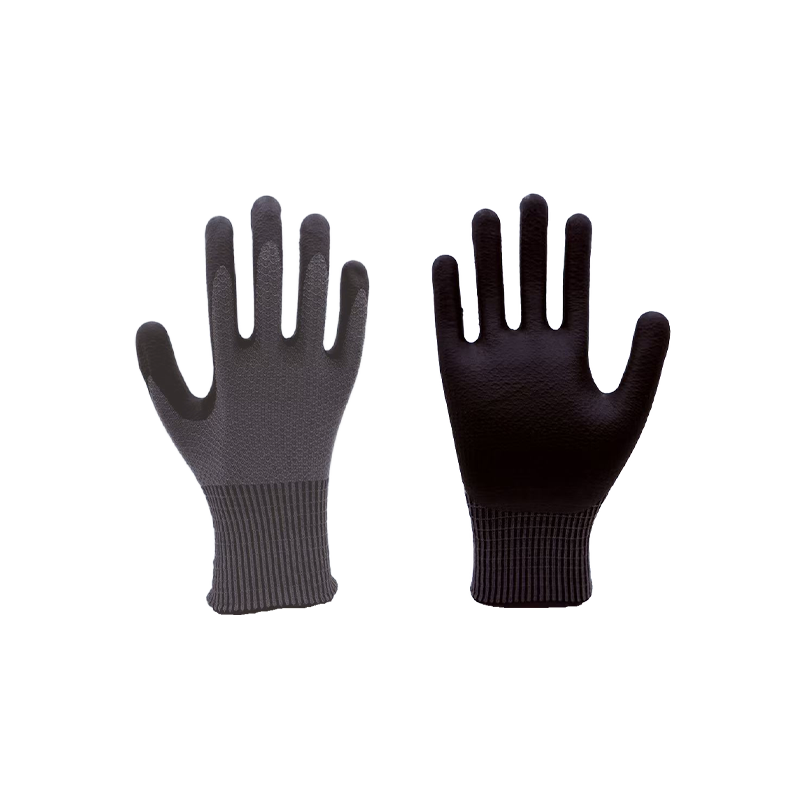 13-gauge A5 Gray High-Performance Cut-Resistant GlovesThis glove is made of lychee-pattern knitted fabric combined with a nitrile foam coating. While maintaining a soft, skin-friendly feel, it provides high-strength prot...View Product →
Use the table below to translate your own task list into a starting level, then confirm it against the supplier's test report and a trial on your line.
| Task | Practical ANSI level | Features that matter |
|---|---|---|
| Moving intact flat glass with polished edges | A3 to A4 | Thin 15 to 18 gauge knit, PU palm, high dexterity |
| Lifting cut-edge sheets and scored offcuts | A4 to A5 | Palm-coated nitrile or PU, snug cuff, no loose fabric |
| Clearing broken glass and cullet | A5 to A6 | Dense knit, wet or dry grip coating, forearm coverage |
| Handling greenware and bisque | A2 to A4 | Abrasion-resistant coating, dust-friendly fit |
| Dipping, glazing and wet tile handling | A3 to A5 | Nitrile foam or crinkle latex for wet grip |
| Kiln mouths, lehr exits and warm ware | A4 to A6 | Heat resistance plus cut protection, longer cuff |
When Your Buyer Asks for EN 388 Instead
European customers will specify EN 388:2016, which reports cut resistance as a letter from A to F in Newtons and reports a traditional coupe-test rating of 1 to 5 alongside it. The two scales are not interchangeable. As a rough guide, an EN level D result (15 to 22 N) lands in the same band as ANSI A4, level E (22 to 30 N) sits near A5, and level F (30 N and above) near A6 — but the pass criteria and reporting format differ, so compare the raw gram or Newton figure whenever a quote gives you one.
- Ask for the test method and the numeric result for the exact style and size you are buying, not just the level printed on a marketing sheet.
- Write the result into the purchase order. A change of yarn supplier can move a glove down a level without any change to the product name.
- Keep one reference pair from each approved batch so future deliveries can be compared by hand, not by memory.
Grip and Coating Decide Whether the Glove Is Actually Worn
A cut-resistant shell that slides on a wet tile is a glove that ends up in a locker. Coating choice therefore matters as much as the A-level, and it changes with the surface:
- Dry glass, tile and metal racks: a thin PU palm keeps dexterity high and grip stable on smooth, clean surfaces.
- Wet glaze, coolant and oily release agents: nitrile foam or crinkle latex, patterned for wet grip, moves liquid away from the contact surface.
- Glaze acids and etchants near sharp edges: the chemical side needs its own answer, and cut-resistant chemical protection gloves cover the case where both risks appear at once.
- Kiln mouths and warm ware: heat resistance has to be built into the same shell, because two gloves rarely fit under one cuff.
Do not assume one coating covers all four. A glove that grips a dry pane can slide across a glazed surface, and a heavy latex coating that grips beautifully in water often feels clumsy when you are lining up a 4 mm pane on a frame.
Sleeves, Cuffs and Forearm Coverage for Full Sheets
Cut injuries on glass lines are not limited to palms. When a full sheet is carried at waist height, the lower edge travels across the forearm, the wrist and sometimes the crook of the elbow. An A4 or higher sleeve extends protection up the arm, and a wire-core arm protector makes sense for palletised, racked or stacked glass where the load can shift mid-carry.
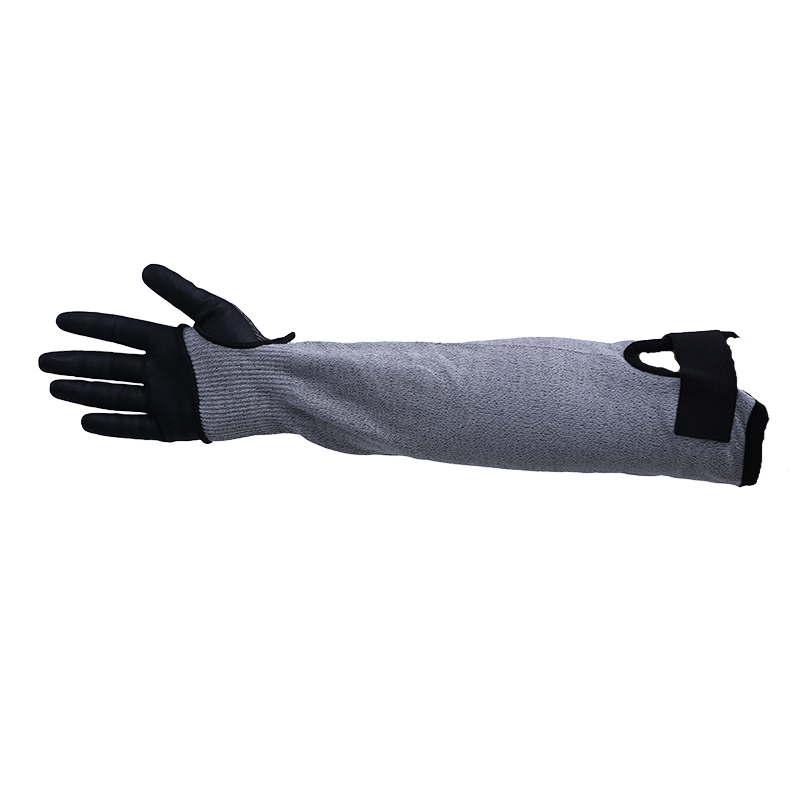 Steel Wire Arm Protector with Velcro StrapThese protective sleeves utilize 13-gauge seamless knitting technology, ensuring a lightweight and elastic product that fits as comfortably as a "second skin." The cor...View Product →
Fit matters as much as level. The sleeve should stay above the wrist through a full shift, allow the elbow to flex, and come off quickly if it snags on a rack or a trolley handle.
A Five-Point Trial Before You Order a Pallet
Weighted criteria make a trial easier to judge. The split below is an illustrative starting point for a glass or ceramics line — adjust the weights to your own incident history and comfort feedback.
- Cut performance 35%
- Wet and dry grip 25%
- Dexterity 20%
- Comfort and durability 12%
- Cost per pair 8%
- Rank your three highest-exposure tasks and time each one across a full shift.
- Ask suppliers for the test method and result for the exact style and size you are trialling.
- Run two adjacent cut levels side by side and log fit, sweat, slippage and pairs consumed per 100 hours.
- Test grip on the real surface: a wet glazed tile, a dusty bisque plate, an oiled rack.
- Compare cost per hour of wear, not cost per pair — a cheap glove replaced twice as often is the more expensive option.
Frequently Asked Questions
Are cut-resistant gloves enough when handling broken glass?
Cut resistance is measured against a sliding blade. Broken glass and ceramic shards concentrate force on a point and can penetrate a cut-resistant shell, so A5 and A6 gloves reduce risk rather than remove it. Use tongs, scoops and a bin you can see into, and never use these gloves against a powered blade.
What cut level fits greenware and bisque?
A2 to A4 is usually enough, because the dominant wear mechanism is abrasion rather than edge cutting. Move up to A4 or A5 when the same operator also handles cut tile edges, trims and mosaic pieces.
Will one glove cover both glass and ceramics work?
Only when the surface is dry and the temperature is normal. Wet glaze changes the coating requirement, and work near a lehr or kiln door changes the heat requirement, so a site matrix of two or three styles normally beats one universal glove.
Glass and ceramics handling rewards a narrow, well-tested specification over a broad catalogue. Pick the A-level from the task, pick the coating from the surface, add arm coverage wherever full sheets are carried, and let a two-week trial — not a data sheet — make the final call.