



 English
 日本語
 русский
 Español
 Deutsch

Content
- 1 Start with the board, not the catalog
- 2 Why PU palm coating fits electronics assembly
- 3 Static control: specify ESD, not just PU
- 4 Fingertip, palm, or full coating: match the process
- 5 The buying checklist: what to ask before a trial
- 6 When assembly includes cutting, stripping, or fixture work
- 7 A practical trial protocol
- 8 FAQ: PU palm coated gloves in electronics assembly
- 9 Qualify a sample pair, then set the spec
Start with the board, not the catalog
If an operator drops a 0402 capacitor or scuffs a connector pin, the glove is part of the process, not a commodity. For many electronics assembly tasks, a thin PU palm coated glove is the practical starting point: it gives tactile feedback through the fingertips, keeps grip on small housings, and leaves the back of the hand breathable during long shifts.
The qualification matters. Standard polyurethane (PU) is not automatically ESD-safe. Use a documented ESD version where sensitive boards are exposed, and keep a non-ESD PU glove for general handling only. That conclusion comes from the trade-offs: nitrile can offer chemical and particulate control but may feel clammy and insulative; latex offers grip but raises allergy and particulate questions; PU palm coating sits in the middle for dry, light assembly, provided the liner, coating weight, and static specification are right.
Why PU palm coating fits electronics assembly
Polyurethane is applied as a thin, flexible film. On a fine-gauge nylon or polyester knit, it adds abrasion resistance and dry grip without the bulk of a dipped nitrile or latex palm. For assembly, that translates into better control when seating flex cables, turning small screws, or handling plastic housings that slip easily.
Dexterity and feedback
Electronics work depends on fingertip feel. A thin PU coating can preserve enough sensitivity to pick up a screw, feel a connector click, or position a gasket without removing the glove. Thicker coatings may improve wear life, but they can also hide the feedback operators rely on.
Grip without tackiness
Dry board handling often needs a secure but clean grip. PU palm coatings are less tacky than some latex or nitrile foams, which helps when handling static-sensitive components and plastic trays. Where the fingertips take the most wear, finger-reinforced PU styles can extend service life without turning the whole glove into a heavy-duty shell.
 Nano Polyester Spandex Finger-Reinforced PU GlovesFinger-reinforced PU gloves for dry board handling where fingertip wear is a concern and a less tacky grip is useful.View Product →
Breathability and comfort
Knitted liners with a palm-only coating let heat escape from the back of the hand. In a production cell, that matters for glove compliance: uncomfortable gloves get pulled off, and a glove that is removed at the wrong moment does not protect the board or the operator.
Static control: specify ESD, not just PU
Electrostatic discharge can destroy or degrade a board without visible damage. A glove that feels thin and comfortable can still be an insulator. For EPA work, require glove data that matches your ESD control plan, commonly aligned with ANSI/ESD S20.20 or IEC 61340-5-1. Ask for resistance test results, the test method, conditioning details, and whether the value is surface resistance or point-to-point resistance.
Antistatic PU gloves use conductive fibers or a dissipative compound to bleed charge. They are not a substitute for grounding the operator, worksurface, and tools. If the glove is laundered, confirm that ESD performance survives the wash cycle.
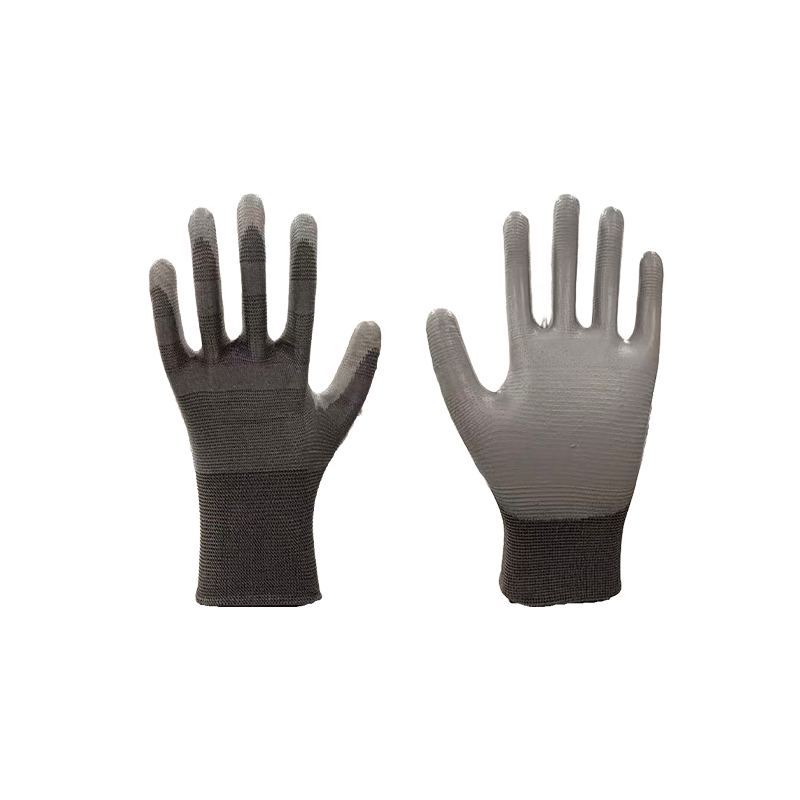 A5 Cut-Resistant Anti-Static PU GlovesAnti-static PU gloves with A5 cut resistance for electronics tasks; verify ESD performance with your grounding layout before production use.View Product →
For high-sensitivity work, sample the glove in the actual EPA, with the same wrist strap and seating arrangement, before releasing it to production. A certificate alone does not prove that the glove works with your grounding layout, humidity, and handling time.
Fingertip, palm, or full coating: match the process
Palm coating is the usual balance for electronics assembly. Fingertip coating gives more feel but less palm wear; full coating protects more of the hand but can reduce breathability and dexterity. Use the table as a starting point, then confirm by task.
| Glove format | Best electronics task | Trade-off | Confirm before purchase |
|---|---|---|---|
| Fingertip-coated PU | Micro-soldering, connector seating, fine lead handling | Least palm abrasion coverage; can wear at high-contact points | Coating placement, liner denier, ESD version |
| Palm-coated PU | General board handling, cable assembly, light fixtures | Good balance of feel and palm wear; back remains breathable | Palm thickness, grip pattern, sizing |
| Full-coated PU | Parts with light oils, dirty fixtures, wet handling | Less breathable; more bulk at the fingers | Chemical compatibility and ESD data |
| ESD PU with conductive liner | Board handling near sensitive components | Must be verified, not assumed; usually higher cost | Resistance report, grounding protocol, laundering effect |
If the cell handles cutting, stripping, or metal fixtures, a standard PU palm glove may not be the best single answer. Put the cut risk and the ESD requirement in the same glove specification rather than solving one problem and creating another.
The buying checklist: what to ask before a trial
Glove catalogs tend to show the same three claims: breathable, dexterous, and durable. A production trial needs harder questions. For a wider comparison of dipping materials, this industrial dipping gloves guide is useful before you narrow the sample list.
- Static documentation: ask for test data on the exact style, not a generic PU glove family. Confirm the test method, resistance range, and whether performance changes after washing.
- Liner and coating: check whether the liner is nylon, polyester, or a blend; fine-gauge knits usually improve feel, while heavier knits may last longer but reduce feedback.
- Cleanliness: standard industrial PU gloves can shed lint. For cleanroom or particle-sensitive work, request washed, low-lint, and cleanroom-compatible packaging.
- Fit and sizing: a loose cuff or short finger can cause dropped parts, wrist exposure, and uneven wear. Size the glove to the hand, not to the glove wall chart.
- Lot traceability and packaging: keep the lot number with the trial data so a later ESD or wear issue can be traced to the correct batch.
- Cut and abrasion needs: if operators cut tie wraps or handle metal edges, specify an appropriate cut level and reinforcement zone instead of accepting premature coating wear.
When assembly includes cutting, stripping, or fixture work
Not every electronics cell is clean board handling. Operators may cut cable ties, strip wire, open clamshells, or handle metal fixtures. In those tasks, a standard PU palm glove can wear through at the thumb crotch or fingertips. A cut-resistant PU glove with reinforced base or a higher cut level may be more economical than replacing thin gloves every shift.
 Cut- and Abrasion-Resistant PU Gloves with Thumb Base ReinforcementPU gloves reinforced at the thumb base for electronics tasks involving cable ties, wire, or metal fixtures where standard palms wear through.View Product →
Do not solve a cut risk by moving to a thick, stiff glove that reduces control. Test the higher cut level against the actual task; if the glove hides fastener feel or increases dropped parts, it may create a different problem.
A practical trial protocol
Run a trial with at least three operators and two shifts. Keep the same board family and task so the comparison is fair.
- Baseline: record the current glove, defect rate, dropped-part count, and change frequency for one week.
- Static check: test the sample glove in the real EPA with the normal wrist strap, seating, and worksurface grounding.
- Handling test: include the smallest fastener, the most awkward connector, and the heaviest housing in the cell.
- Comfort and fit: ask operators about sweat, finger pinching, cuff creep, and donning time after washing hands or changing shifts.
- Wear and replacement: inspect thumb crotch, fingertips, and palm after each shift; replace when grip drops or coating is worn through.
- Packaging: check that the gloves arrive flat, clean, and traceable, especially if they are removed from the bag near exposed boards.
FAQ: PU palm coated gloves in electronics assembly
Are PU palm coated gloves ESD safe?
Only when the glove is specifically manufactured and tested for ESD. Standard PU is not automatically dissipative, so ask for resistance data and verify the glove in your EPA.
Can nitrile gloves be used instead?
Yes for some cleanroom or chemical tasks, but standard nitrile is insulative and less breathable than a knit PU palm glove. ESD nitrile options exist, so compare test data rather than color or material name.
How long should the gloves last?
Replace them when the coating is worn, grip drops, contamination is visible, or ESD performance falls out of specification. A fixed calendar replacement interval is weaker than task-based inspection.
Do PU gloves work in cleanrooms?
Only low-lint, washed, or cleanroom-compatible versions should be considered. Standard industrial liners can shed fibers, so confirm particle and packaging controls before use near exposed boards.
Qualify a sample pair, then set the spec
The right PU palm coated glove is the one that passes your ESD test, fits the operators, and keeps the board clean and controllable. Start with a small sample, document the liner, coating, resistance, and size, then lock the purchase specification. If you need help matching a PU style to your assembly task, contact us with the board type, ESD requirement, and expected change frequency.
For a quotation or sample discussion, contact us and include the task, glove size range, and any ESD standard your line follows.