



 English
 日本語
 русский
 Español
 Deutsch

Content
- 1 The Three Roles a Bay Glove Rotation Has to Cover
- 2 What Actually Causes Hand Injuries Under a Hood
- 3 Match the Glove to the Task: A Bay-by-Bay Reference
- 4 Precision Work: Thickness Decides More Than Cut Level
- 5 Oil, Fuel and Brake Fluid: Coating Choice Beats Fabric
- 6 Impact and Vibration: When Seized Bolts Fight Back
- 7 Spec Sheet Basics: Cut Levels, Gauges and Cuffs
- 8 Buying for a Shop: Checks Before a Bulk Order
- 9 Frequently Asked Questions
A rotor dust shield that has already sliced two knuckles, a 10 mm socket lost in an oil pan, a caliper still too hot to grab — that is usually when a technician starts shopping for gloves. The useful answer is not one perfect pair.
Three roles cover almost every job in a bay: a thin palm-coated pair for fasteners, connectors and trim; a cut-resistant pair with a nitrile or latex dip for oil-covered metal; and a heavier padded pair for seized bolts, exhaust work and salvage-yard steel. Pick those three deliberately and hand protection works. Buy one "universal" pair and it comes off within twenty minutes, because nobody can feel a bolt head through it.
The Three Roles a Bay Glove Rotation Has to Cover
Automotive work pulls a glove in four directions at once. It has to resist cutting, hold grip on oily metal, survive contact heat, and stay thin enough to pick up a fastener. No single construction does all four well.
- Precision role: 15-gauge or 18-gauge knit with a thin PU palm dip, cut level A2 to A5. Connectors, trim clips, small fasteners, sensor swaps.
- Wet-grip role: 13-gauge or 15-gauge knit with a nitrile foam or sandy nitrile palm, cut level A3 to A5. Oil changes, filters, suspension, anything that comes out greasy.
- Heavy role: A6 knit with TPR padding across the back of the hand, or a fully dipped glove with a 30-35 cm cuff. Rusted fasteners, air tools, exhaust parts, recovery-yard metal.
A rotation also stretches service life: the thin pair is not burned on a manifold, and the padded pair is not worn out on a fuse box.
What Actually Causes Hand Injuries Under a Hood
Glove marketing focuses on cut resistance, but the injury mix in a real bay is wider.
- Stamped edges: rotor backing plates, dust shields, heat shields, hose clamps and cut zip ties produce the small, deep cuts that end a shift early.
- Fluids: engine oil, ATF, coolant, diesel, penetrating oil and brake fluid. Brake fluid and solvents are the aggressive ones; a glove that shrugs off oil can let brake fluid through in minutes.
- Contact heat: manifolds, converters and turbo piping. Synthetic knits can melt and stick, which is worse than no glove — leather and aramid constructions behave better.
- Impact and grip loss: a breaker bar slipping off a rusted bolt, or a glove that slides on an oily fastener, turns a controlled pull into a sudden one.
- Entanglement: near bench grinders, drill presses and rotating shafts, a glove can be caught and pulled in. Remove them for those operations.
Match the Glove to the Task: A Bay-by-Bay Reference
The task usually decides construction faster than any spec sheet. This table is the short version of what works where.
| Task | Recommended construction | Typical cut level | Main risk |
|---|---|---|---|
| Brake and suspension teardown | 15-gauge knit, nitrile foam palm dip | A4 | Rotor edges, dust shield burrs |
| Oil and filter changes | 13-gauge knit, full nitrile dip, 30-35 cm cuff | A2 to A3 | Hot oil, wicking at the cuff |
| Electrical, connectors, trim | 18-gauge knit, thin PU palm dip, antistatic | A2 to A5 | Static damage, loss of feel |
| Exhaust, turbo, cooling system | Aramid or leather, heat resistant | A3 to A5 | Contact heat, coolant soak |
| Parts washer and solvent work | Supported nitrile, chemical protection | A3 or higher | Permeation through the film |
| Salvage yard, cutoff wheels, seized bolts | A6 knit with TPR back-of-hand padding | A6 | Pinch, vibration, torn metal |
Precision Work: Thickness Decides More Than Cut Level
If a technician cannot pick a washer off a bench, the glove comes off and protection drops to zero. That is why an 18-gauge liner with a 1.0-1.2 mm PU palm beats a thick 13-gauge A5 glove for interior and electrical work, even though the A5 carries the higher rating.
Two details settle it. Gauge: finer yarn means better feel, so 18-gauge outperforms 13-gauge at the same cut level in tight spaces. Dip coverage: a palm dip leaves the back of the hand open and cooler, while a full dip keeps oil out but adds bulk. For connectors and sensors, an antistatic PU version also protects sensitive electronics.
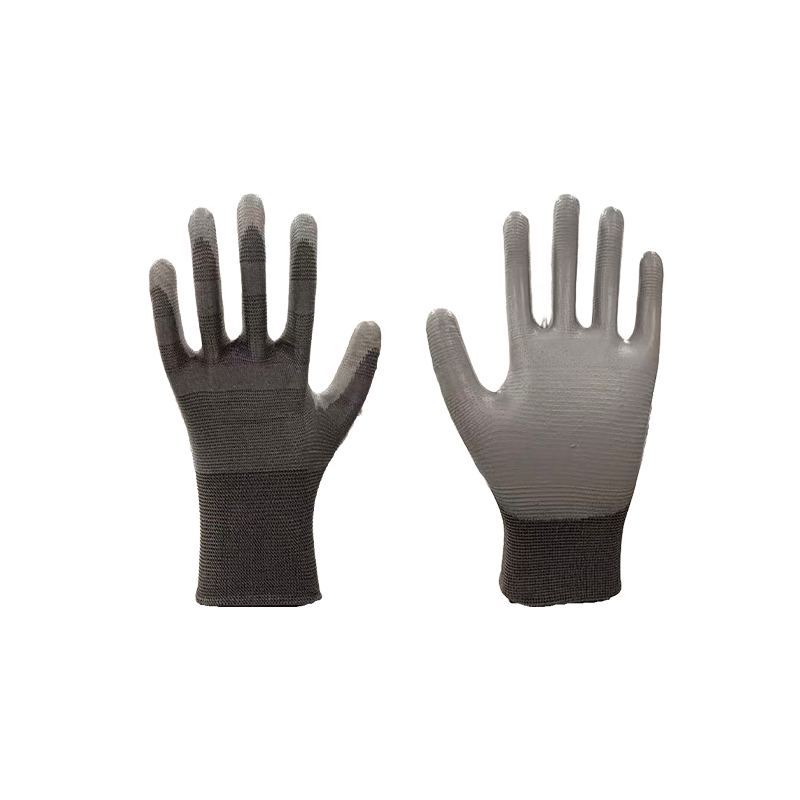 A5 Cut-Resistant Anti-Static PU Dipped GlovesA5 cut-resistant, anti-static PU-dipped gloves for panel edges and small fasteners where feel and static control matter.View Product →
Our A5 PU dipped option sits in the middle of that range: cut protection for panel edges with enough feel for a 10 mm bolt head.
Oil, Fuel and Brake Fluid: Coating Choice Beats Fabric
Cut-resistant liners are built from aramid, HPPE or glass-fiber blends, and none of those fibers stops liquid. The coating does. Nitrile handles oil, grease and many fuels; latex gives stronger wet grip but less chemical resistance; PU is the thinnest and the weakest against chemicals.
Two rules prevent most problems. Match cuff length to the way fluids travel — a 35 cm fully dipped glove stops oil wicking up the forearm during drain plug and hose work. And treat brake fluid and solvents as a permeation problem rather than a splash problem: check breakthrough time on the data sheet instead of trusting the phrase "chemical resistant."
 35cm Long Fully Immersed Latex GlovesOil-proof, non-slip 35 cm fully immersed latex gloves for fluid-heavy jobs, reaching up the forearm to limit oil wicking.View Product →
The trade-off is warmth and stiffness, so keep the long-cuff pair for fluid-heavy jobs rather than general disassembly.
Impact and Vibration: When Seized Bolts Fight Back
Rusted fasteners and air tools call for padding. TPR across the back of the hand and knuckles absorbs part of the force when a breaker bar slips, and it also cuts the tingle that builds during an hour with an impact wrench.
Cut level matters too. A4 covers general work; A5 to A6 makes sense when cutting brake lines, handling salvage metal or pulling panels with torn edges. The cost is dexterity and heat, so the heavy pair belongs in the toolbox until the job asks for it.
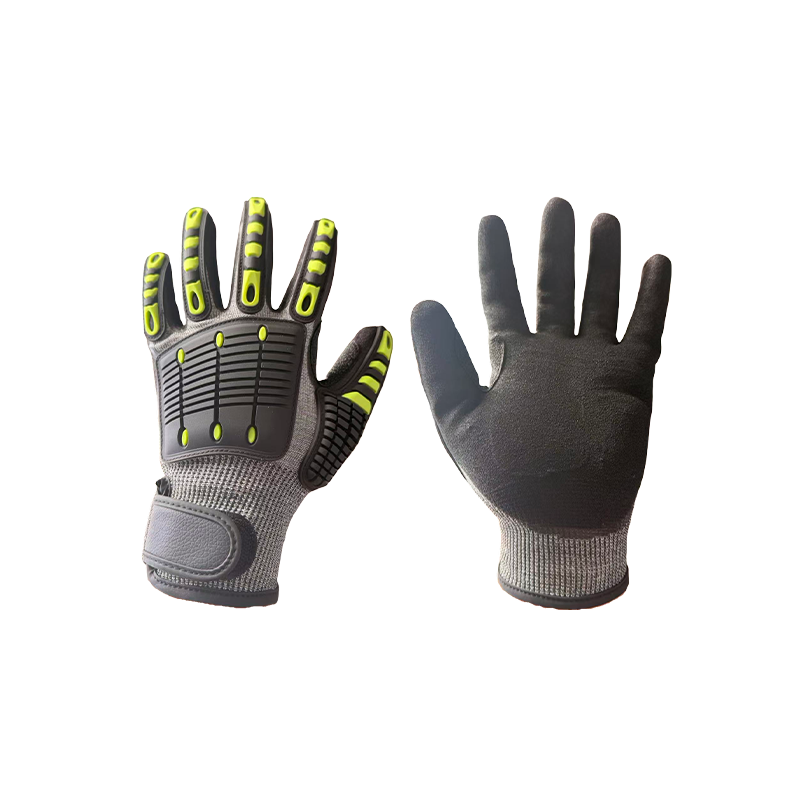 A6 Cut-Resistant TPR Shock-Absorbing GlovesA6 cut-resistant TPR shock-absorbing gloves for cutting brake lines or salvage metal; proper fit is essential for padding to work.View Product →
Padding only works when the fit is right — a loose padded glove slides, gives a false sense of protection and blisters the hand.
Spec Sheet Basics: Cut Levels, Gauges and Cuffs
Two rating systems appear on glove packaging, and they are not interchangeable.
- ANSI/ISEA 105: cut levels A1 through A9 based on gram load from the ASTM F2992 test. Automotive maintenance mostly lands in A2 to A5; A6 and above belongs to salvage, cutting and heavy sheet metal.
- EN 388:2016: four mechanical scores plus a letter A to F from the ISO 13997 cut test. Compare the letter with ANSI.
- Gauge: 13-gauge is the workhorse, 15-gauge is thinner and often sufficient, 18-gauge gives the best feel.
- Cuffs: knit cuffs breathe; safety cuffs and gauntlets keep fluid and debris out.
If cut performance decides between suppliers, this guide to how to choose cut-resistant gloves maps levels to tasks in more detail.
Frequently Asked Questions
Are disposable nitrile gloves enough for brake fluid?
Rarely for long exposure. Glycol-based brake fluid permeates thin nitrile quickly, so use a heavier supported nitrile or a chemical-protection glove and replace it as soon as it is contaminated.
What cut level do automotive technicians need?
A3 to A5 covers most daily work. Drop to A2 where feel matters most, and move to A6 or higher for salvage metal, cutting or torn sheet metal.
Can gloves be worn at a bench grinder or drill press?
No. Rotating equipment can catch the fabric and pull the hand in, so remove gloves for those operations and follow the shop's machine safety rules.
The practical summary: buy three glove roles instead of one, test sizing before a bulk order, and treat brake fluid and rotating equipment as their own separate problems. A rotation that stays on the hands all shift protects better than a single pair that comes off by nine in the morning.
Dongfeng Gloves manufactures cut-resistant, dipped, mechanical, thermal and chemical protection gloves from a 10,000 square meter facility in Rugao, Jiangsu, and supplies them as part of a complete hand protection program.