


 English
 日本語
 русский
 Español
 Deutsch

Content
- 1 Step 1: Define the Glove Before You Contact a Factory
- 2 Step 2: Judge the Factory, Not the Catalogue
- 3 Step 3: Match the Hazard, Then Verify the Report
- 4 Step 4: Run a Sample That Proves Something
- 5 Step 5: Read the Quote, Not Just the Unit Price
- 6 Mistakes That Cost Buyers Money
- 7 Frequently Asked Questions
Two quote sheets land on the same desk for the same glove: a 13-gauge cut-resistant liner with a nitrile foam palm. One is $0.62 per pair, the other $0.94. Both factories are in Jiangsu, both print "ANSI A5" on the line, and both promise 30-day delivery. The gap is rarely labour. It is the liner fibre, the yarn count, the coating weight, the number of dips, and whether anyone actually tested the finished glove at the level written on the quote.
So work in this order: fix the specification, fix the evidence, then qualify the factory against both. Buyers who reverse that sequence spend the next six months explaining why mass production feels stiffer, thinner and less grippy than the sample that won the order.
Step 1: Define the Glove Before You Contact a Factory
A quotation is only comparable when the product behind it is defined. Five variables decide whether two suppliers are quoting the same glove: cut level, liner and gauge, coating, cuff length, and size range. Change one and the factory changes yarn, machine settings or dipping compound.
Cut level sets the floor
ANSI/ISEA 105 cut levels run from A1 to A9. Most industrial purchasing sits between A2 and A6, and the right level depends on what the hand touches, not on the name of the industry. A5 is common in glazing, metal stamping and waste sorting; A2 covers light assembly and packaging, where dexterity matters more than blade resistance. Compare the finished, coated glove as tested: a liner that reaches A4 does not guarantee a coated glove at A4.
| Cut level | Typical work | Liner and gauge behind it |
|---|---|---|
| A2 | Light assembly, packaging, dry parts | 13-gauge aramid or HPPE blend |
| A3 | General handling, cold-weather work | HPPE liner with warm lining |
| A4 | Sheet metal, glass, maintenance | 13-gauge HPPE, PU or nitrile palm |
| A5 | Glazing, stamping, waste sorting | 13 to 18-gauge HPPE, nitrile foam |
| A6 | Blades, sharp sheet, high exposure | HPPE and steel blend with TPR back |
| A7 to A8 | Extreme cut exposure, short duration | Dense HPPE or steel yarn, low gauge |
Gauge, coating and cuff length
Gauge is the stitch density of the knitted liner. A 13-gauge liner is thicker, more durable and cheaper to knit; an 18-gauge liner is finer and more sensitive but costs more per kilogramme of yarn. Coating follows the working condition: nitrile foam for oily or slightly wet parts, PU for dry precision handling, latex for wet grip and abrasion, water-based PU where chemical splash resistance is also required. A 24 cm cuff suits general handling; 35 cm covers the forearm in deep-reach or dipping tasks. If the cut level is still unclear, our guide on choosing cut-resistant and cut-proof gloves explains how the test is run and where each level is normally specified.
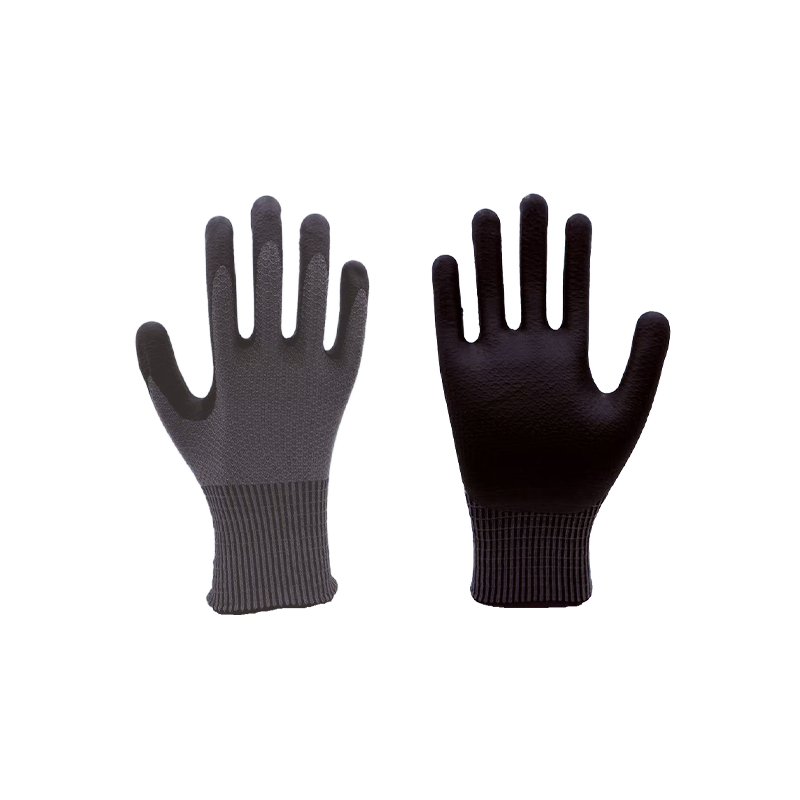 13-Gauge ANSI Cut A5 Gray Cut-Resistant GlovesA 13-gauge gray glove in the ANSI Cut A5 range; the page provides a product parameters section and inquiry option for buyers comparing cut protection.View Product →
Step 2: Judge the Factory, Not the Catalogue
Glove suppliers in China are not interchangeable. Some knit their own liners and run their own dipping lines. Some buy greige liners from a knitting mill and only dip them. Others are trading offices with a rented showroom. Three questions separate them quickly: which processes run under your roof, who tests the finished glove, and what happens to a batch that fails?
Our own facility in Rugao, Jiangsu shows what a vertically integrated setup looks like. The company was founded in 2010 and since 2013 has combined development, production, quality inspection, sales and after-sales service in one operation. The site covers roughly 10,000 square metres, including about 4,500 square metres of production floor. The range runs from A2 to A8 cut protection through nitrile, latex and PU dipped gloves to function, mechanical, heat and chemical protection, plus custom work. That is what one-stop hand protection means in practice: one specification, one quality system, one set of shipping documents. Rugao also sits in the Yangtze River Delta close to Shanghai, which keeps container consolidation to Shanghai or Ningbo straightforward.
Dipping is where consistency is won or lost. Coating weight, dwell time and curing temperature decide whether a nitrile foam palm stays grippy after ten wash cycles or turns shiny and slick. A factory that controls its own dipping parameters can hold those settings batch to batch, and can build combinations such as a bamboo-fibre liner with a nitrile foam coating for moisture management in warm workshops.
 Bamboo Fiber Impregnated Nitrile Foam GlovesListed under nitrile dipping gloves, this bamboo fiber and nitrile foam style includes product parameters and inquiry sections for checking specification details.View Product →
Step 3: Match the Hazard, Then Verify the Report
Cut resistance is only one risk. Chemical permeation, heat, impact, abrasion and static discharge all change the glove you should buy. A Type A chemical glove, for instance, is tested for permeation breakthrough against at least six chemicals; a "chemical resistant" claim on a product page is not the same evidence.
Ask for the test report rather than the certificate alone. A certificate usually covers a management system or a model family; a report names the laboratory, the standard version, the glove model, the batch and the date. Check that the model on the report matches the model on the quotation, and that the report still describes the current construction. If a factory reformulates a coating or switches liner supplier, the old report may no longer apply to what you are buying.
Step 4: Run a Sample That Proves Something
A single pair in a plastic bag proves very little. Order samples in two or three sizes, put them on the hands that will wear them for a full shift, then wash and dry them five to ten times before judging grip, coating adhesion and liner shrinkage. Cut performance measured on a new glove can fall after laundering, so retest the washed sample when the application is high risk.
Before mass production, seal a golden sample with the factory, sign off the packaging artwork and agree the inspection standard; AQL 2.5 for major defects is a common starting point for gloves. Then have a random pair from the finished batch tested by a third-party laboratory. That test costs little next to a container of gloves nobody can use.
Step 5: Read the Quote, Not Just the Unit Price
An FOB unit price is a summary of choices. Two factories can both quote $0.70 a pair while using different yarn, coating weights and testing. The table below shows where the money goes and where a buyer can push back without touching safety performance.
| Cost driver | Why the price moves | Buyer leverage |
|---|---|---|
| Liner fibre | Aramid and steel blends cost several times more than polyester | Match cut level to the task instead of over-specifying |
| Gauge | Finer yarn costs more per kilo, though it uses less material | Choose 18-gauge only where dexterity is genuinely needed |
| Coating and dips | Foam nitrile, double dips and water-based PU add compound and machine time | Keep one coating across a range where the task allows it |
| Testing | Cut and permeation tests add a fixed cost per model and batch | Share one report across the sizes of a single construction |
| Tooling and branding | New moulds, printed logos and retail cards are one-off costs | Buy stock sizes first and customise on the repeat order |
| Terms and logistics | EXW, FOB and CIF change who pays freight, insurance and duty | Compare landed cost, not the unit price alone |
MOQ follows the same logic. Stock constructions often start at a few hundred pairs per size, while a custom colour, printed logo or retail header card usually pushes the minimum into the thousands, because the line has to be cleaned and reset. Ask for a price broken down by size, confirm how long the quotation holds, and compare landed cost rather than the first number on the page.
Mistakes That Cost Buyers Money
- Buying on unit price and discovering the glove is 2 cm shorter or 20 g lighter than the sample.
- Accepting "same as sample" instead of a written specification with tolerances.
- Skipping the factory audit because a video call looked convincing.
- Over-specifying cut level and paying for fibre the task never needed.
- Leaving packaging, labelling and carton marks undefined until the order is ready to ship.
- Depending on one supplier and one shipment date with no buffer.
Frequently Asked Questions
What is a realistic MOQ for dipped gloves?
For stock constructions, several hundred pairs per size is common. Custom colours, logos or retail packaging typically start in the low thousands, because dipping and printing setups have to be changed.
How long does production take?
Repeat orders of stock items often ship three to four weeks after deposit. New constructions and custom packaging take longer because of sampling, testing and raw material lead time.
Can I put my own brand on the gloves and packaging?
Usually yes, at a defined MOQ. Confirm where the branding appears, such as glove print, hang tag, polybag or carton, and approve a sample of each element first.
How do I verify a factory I cannot visit?
Ask for a live video walk-through of the knitting and dipping areas, the test report with the laboratory name, and a third-party inspection report from an earlier shipment. Together they filter out most trading offices.
Sourcing PPE gloves from a China factory is not difficult. Sourcing them without a written specification, a verified test report and a sealed golden sample is. Fix those three and the price conversation becomes short, factual and far cheaper over a year of repeat orders. If you want to check a specific construction against your own hazard assessment, send us your glove specification and we will tell you what will and will not hold up in production.